
Companies to hold rates in Delhi until new government is formed.

The over $7 billion Iran- Pakistan-India gas pipeline project has been found to be technically feasible but its economic viability will depend on the price at which Tehran sells the fuel, the Centre said on Tuesday.

'We need to be very vigilant as we are passing through some fraught times.'
The pricing of natural gas will be discussed by the group of ministers concerned on January 29, Union Petroleum Minister Ram Naik said on Wednesday. \n\n\n\n
India and Pakistan will soon finalise the details of the pipeline that will bring natural gas from Iran, a top Pakistan government official said in Islamabad.
A committee of secretaries is already looking into the issue of pricing, which companies like RIL, British Gas and British Petroleum have said should be market-determined.
India on Monday sought fuel from Qatar to restart the $2.9-billion Dabhol power project in Maharashtra.
On the insistence of petroleum minister Murli Deora, Russian Prime Minister Vladimir Putin is sending Shmatko to attend the conference of energy ministers of the Commonwealth of Independent States that New Delhi is hosting on November 25-26.

The wholesale inflation rose for the third consecutive month in May at 2.61 per cent on account of rise in prices of food articles, especially vegetables, and manufactured items. The wholesale price index (WPI) based inflation was 1.26 per cent in the previous month. It was (-) 3.61 per cent in May 2023. "Positive rate of inflation in May, 2024 is primarily due to increase in prices of food articles, manufacture of food products, crude petroleum & natural gas, mineral oils, other manufacturing etc," the ministry of commerce & industry said in a statement on Friday.
The scheme will cost the state exchequer altogether Rs 1,650 crore.

According to industry experts, the consumption of petroleum products in the month of April was only 30-40 per cent of what it had been prior to the lockdown. Due to this, refineries were forced to bring down their capacity too.

Of Trump's reciprocal tariffs and trade deals
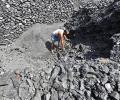
The output of eight core sectors grew by 11.6 per cent in August, mainly due to an uptick in the production of cement, coal, and natural gas, official data showed on Thursday. The eight infrastructure sectors of coal, crude oil, natural gas, refinery products, fertilisers, steel, cement and electricity had contracted by 6.9 per cent in August 2020 due to the nationwide lockdown imposed to control the spread of COVID-19. The eight core industries comprise 40.27 per cent of the weight of items included in the Index of Industrial Production (IIP).
The government on Monday refused to review its decision rejecting the price of natural gas proposed to be sold by Reliance Industries Ltd to an Anil Ambani group firm.
Anil Ambani Group firm Reliance Fuel Resources Ltd has sought government permission to lay a Rs 16,000-crore (Rs 160 billion) pipeline to take natural gas from Reliance Industries-operated field off the Andhra coast to its power plant at Dadri in UP.

The government on Thursday more than doubled the price of natural gas that is used to produce electricity, make fertilisers, turned into CNG and piped to household kitchens for cooking, on the back of a spike in global energy prices. The price of gas produced from old regulated fields, such as the nation's largest gas field of Bassein of ONGC, will rise to a record high of $6.10 per million British thermal unit (mmBtu) from the current $2.90 per mmBtu, according to the oil ministry's Petroleum Planning and Analysis Cell (PPAC). The new price, which is likely to result in a hike in CNG and piped cooking gas rates, will be for six months beginning April 1.

The wholesale price-based inflation declined to 4.95 per cent in December 2022, mainly due to fall in prices of food articles and crude petroleum. The Wholesale Price Index (WPI)-based inflation was 5.85 per cent in November 2022 and 14.27 per cent in December 2021. Inflation in food articles was (-)1.25 per cent, while in fuel and power it was 18.09 per cent during December 2022.
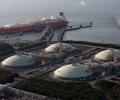
Around 15 years ago, when Reliance Industries (RIL) struck natural gas in the Krishna-Godavari (KG) basin off the east coast, the government made plans to supply that fuel cheaply to scores of generators that sprang up in India triggered by the discovery. Most of the plants, which account for 6 per cent of India's total generation capacity, operate sparsely after the KG-D6 area first failed to meet production targets, and then finally shut shop. Affordable domestic gas was why those thermal plants came up and the rate of the fuel today is why those generators hardly operate. Record liquefied natural gas (LNG) rates may yet again unravel India's ambitions to expand use of gas in industries, households and vehicles. Rates, while volatile, may stay strong this decade as developed nations with higher purchasing power embrace gas as the transition fuel.
In an attempt to hold on to its exploration blocks in the Krishna-Godavari basin, Oil and Natural Gas Corporation is in talks with British Gas (BG) and British Petroleum (BP) for joint exploration in four offshore blocks in the region.
Reliance Industries Ltd will invest $8.84 billion in producing 80 million standard cubic meters per day (mmscmd) of gas from its KG-D6 block in Krishna Godavari basin.
Indications emerged on Friday on the possibility of India and Iran reviving an LNG deal struck last year, with Tehran offering a new price and New Delhi saying it was willing to raise its offer slightly.

India on Monday lost the ONGC Videsh Ltd-discovered Farzad-B gas field in the Persian Gulf after Iran awarded a contract for developing the giant gas field to a local company. "The National Iranian Oil Company (NIOC) has signed a contract worth $1.78 billion with Petropars Group for the development of Farzad B Gas Field in the Persian Gulf," the Iranian oil ministry's official news service Shana reported. "The deal was signed on Monday, May 17, in a ceremony held in the presence of Iranian Minister of Petroleum Bijan Zangeneh in Tehran." The field holds 23 trillion cubic feet of in-place gas reserves, of which about 60 per cent is recoverable.

The President said he made the decision in consultation with European allies but added they may not be in a position to join the US in banning Russian energy imports.

A Texas company will submit a report by June on whether a company controlled by RIL 'stole' natural gas from the wells where ONGC is contracted to operate in the KG basin, as alleged by ONGC.
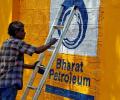
BPCL is a high revenue-earning public-sector undertaking (PSU) and plans to privatise it are completely off the table, Petroleum and Natural Gas Minister Hardeep Singh Puri said on Tuesday after assuming charge of the ministry for the second time. "Why would we divest ourselves of highly successful Maharatnas like BPCL," Puri said, arguing the Centre was not in favour of divesting its stake in oil PSUs.

Wholesale price-based inflation spiked to a record high of 15.08 per cent in April on rising prices across segments from food to commodities. The WPI-based inflation was 14.55 per cent in March and 10.74 per cent in April last year. "The high rate of inflation in April 2022 was primarily due to rise in prices of mineral oils, basic metals, crude petroleum & natural gas, food articles, non-food articles, food products and chemicals & chemical products etc. as compared to the corresponding month of the previous year," the commerce and industry ministry said in a statement.
A Committee of Secretaries will meet on July 6 to discuss pricing of natural gas to be produced from Reliance Industries' block off the east coast and whether the Centre should take its share in cash or kind.

The wholesale price-based inflation rate declined to (-) 4.12 per cent in June on easing prices of food, fuel and manufactured items. The wholesale price index (WPI) based inflation in May was (-) 3.48 per cent. In June last year, it was 16.23 per cent.

The government had in October 2007 set a sale price of $4.20 per million British thermal unit based on the price discovered by RIL from key customers.
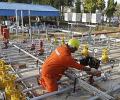
India's top oil and gas producer ONGC on Friday reported a tripling of net profit in the June quarter as it earned record prices before the government slapped a tax on windfall profits arising from a global rally in energy rates. Oil and Natural Gas Corporation's (ONGC) standalone net profit at Rs 15,205.85 crore, or Rs 12.09 per share, in April-June, compared to Rs 4,334.75 crore, or Rs 3.45 a share, in the same period a year back, according to a stock exchange filing by the company. Sequentially, the profit was higher than the Rs 8,859.54 crore net profit of January-March.

Petroleum being out of the goods and services tax initially will create some anomaly as tax credit on some of the inputs to oil industry may not be given, said revenue secretary Hasmukh Adhia.

Russia's state-owned oil firm Rosneft has agreed to supply up to 500,000 barrels per day (bpd) of crude oil to Indian upstream oil and gas major Reliance Industries (RIL) in the largest-ever energy deal between the two countries, Reuters reported on Thursday. The 10-year agreement amounts to 0.5 per cent of global oil supply and is valued at roughly $13 billion per year at current prices, it said.

The Delhi high court has rejected a government challenge to an arbitration panel award that had ruled in favour of Reliance Industries Ltd in a dispute over gas migration from fields operated by state-owned ONGC in the KG basin. The government had slapped a provisional penalty of $1.55 billion on Reliance for "unjust enrichment" from gas migrating from the ONGC-operated KG-D5 block to the private firm's adjoining KG-D6 area. It had sought $175 million in additional profit petroleum from Reliance and its UK partner BP Plc.

The wholesale price-based inflation eased to 10.66 per cent in September, helped by moderating food prices even as crude petroleum witnessed a spike. WPI inflation remained in double-digit for the sixth consecutive month. In August, it was 11.39 per cent. In September 2020, inflation was 1.32 per cent. "The high rate of inflation in September 2021 is primarily due to rise in prices of mineral oils, basic metals, non-food articles, food products, crude petroleum & natural gas, chemicals and chemical products etc. as compared the corresponding month of the previous year," the commerce and industry ministry said in a statement.

Anjanappa, chief of the Chikkaballapur unit of the party, has alleged that several crores of rupees were involved in the alleged scam and hence a probe had to be initiated.

Wholesale price-based inflation rose to a record high of 15.88 per cent in May on rising prices of food items and crude oil. The Wholesale Price Index-based inflation was 15.08 per cent in April and 13.11 per cent in May last year. "The high rate of inflation in May, 2022 is primarily due to rise in prices of mineral oils, crude petroleum & natural gas, food articles, basic metals, non-food articles, chemicals & chemical products and food products etc. as compared to the corresponding month of the previous year," the commerce and industry ministry said in a statement.
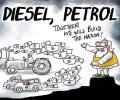
The Centre has garnered around Rs 2,500-3,000 crore in the first five weeks after it imposed a windfall tax on oil and gas companies for the export of fuel, Business Standard has learnt. It is likely that the government will continue with the one-time tax till the Indian crude basket is above $80 a barrel, sources said. The next review of the windfall tax on oil companies is early next week.
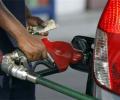
The Centre would need the concurrence of 20 states out of 29 to impose a GST on petroleum
